First place at Techstars × Build Club, a searchable database of the founders investors miss
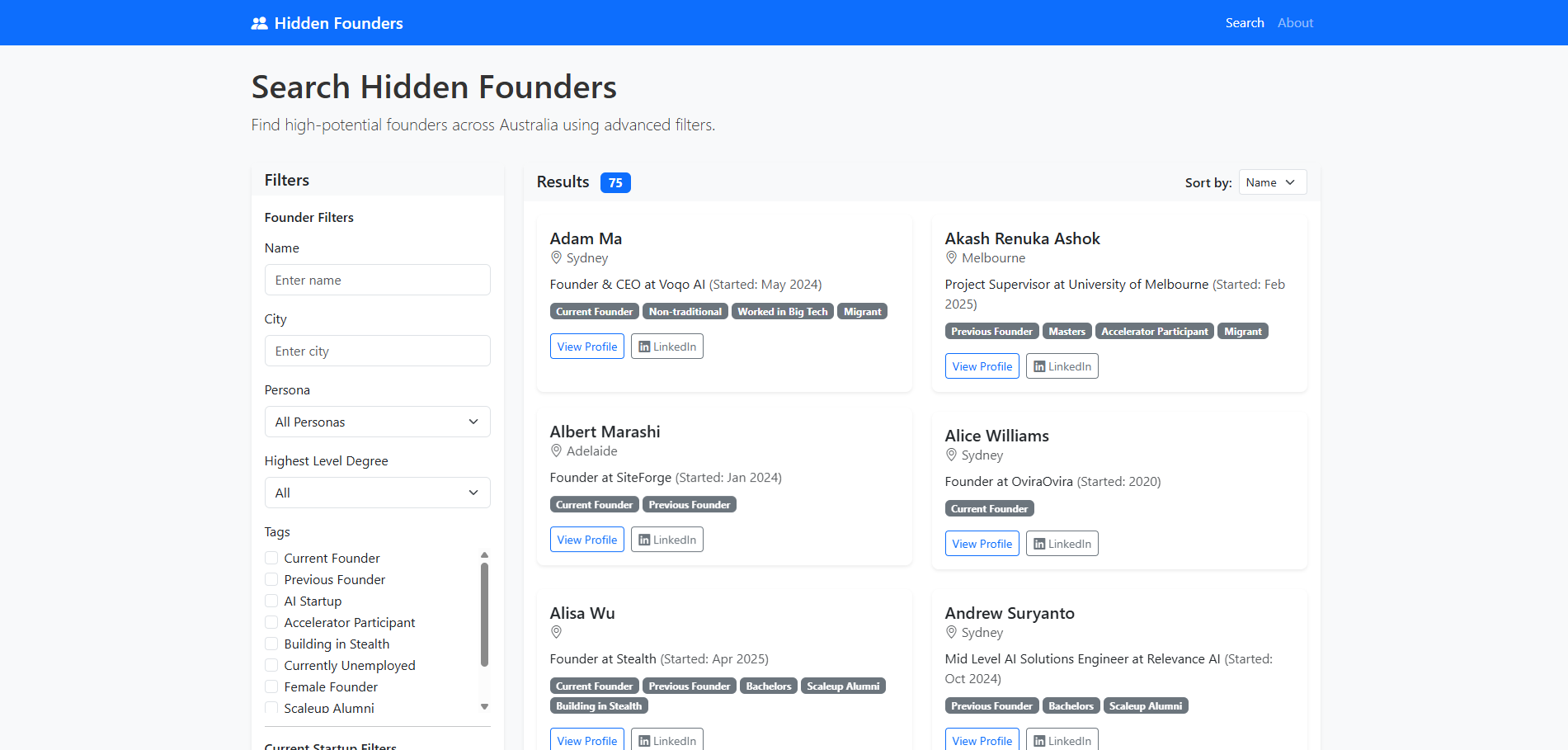
The brief was to find hidden founder talent in Sydney, the people building something real who never show up in the places investors look. We built a searchable database that finds them from public signals, enriches each profile, and turns it into filters an investor can search on. It ended up winning.
“Michelle Lieng and Andy Su were our winners. They found 125 incredible people for us to reach out to.”
 Christie JenkinsManaging Director · Techstars Tech Central Sydney Accelerator
The problem
Investors find founders the way everyone does, through the ones already visible, so discoverability gets mistaken for potential. That leaves out founders who are disproportionately women and migrants, people findable in public data but invisible to the usual search.
The process
We invert the usual search, running targeted LinkedIn queries and then filtering out the high-follower, long-tenure profiles everyone else surfaces. Cutting the obvious candidates is the whole mechanism. From there we scrape each public profile and enrich it against the open web, then let simple rules handle the predictable fields and AI tag the messy ones. Every record is validated before it is stored.
Take one profile. LinkedIn gives a name, a title and a headline. Crunchbase and the open web add funding stage and industry. Regex pulls out anything with a consistent shape, like a degree or job title, and Gemini takes what regex cannot: summarising a startup's own description into an industry tag, or judging from a bio whether someone reads as a past founder rather than an early employee.
Here is the whole thing running, start to finish.
- Targeted search
- LinkedIn queries across cities and founder terms, filtered to exclude the already-visible.
- Community signals
- Founders active in university and startup Slack groups, including women-only communities that surface female founders no follower search would reach.
- Read and enrich
- Each public profile pulled into one format, then enriched with funding stage and industry from Crunchbase and the web.
- Regex vs AI
- Regex handles anything with a consistent shape, like a degree or job title. Gemini takes what regex cannot, turning messy text into clean tags: past founder, migrant founder, in stealth, accelerator alum.
- Filterable site
- Pick the filters that matter and get back real profiles, not a list to go and research.
The result
A deployed product, first place in the challenge, built in a week. An investor filters on what matters and gets real profiles back.
The database surfaced 125 founders for Techstars to reach out to. They contacted 60 of them, and 10 went on to apply to the Techstars Sydney Accelerator's 2025 cohort. The same approach works for any niche where the people you want are findable but hard to search for.
Built with
- React
- Vite
- Bootstrap
- Python
- Flask
- MySQL
- AWS RDS
- AWS EC2
- Selenium
- Gemini
- pandas
- pydantic
Questions we get asked about this
What makes a founder "hidden", and how do you find them?
Hidden means findable in public data but invisible to the usual search, usually without a big following or a loud launch, sometimes still in stealth. We invert the query, running searches across cities and founder terms while filtering out high-follower, long-tenure profiles, plus signals from university and startup communities.
Where does the data come from?
Public sources only. Searches surface candidate profiles, the system reads each into a consistent format, and a second pass adds context like funding stage and industry from the open web.
Why use AI at all, rather than just rules?
Both, each where it is stronger. Rules handle anything written predictably. The AI takes the messy parts, like summarising what a company does or judging whether someone reads as a past founder.
How fast did you build it?
We joined with 10 days left and had a working product in about a week, two of us in parallel, one on discovery and tagging, the other on the full-stack build.
Could you build something like this for us?
Yes. The same approach, discovery, enrichment and clean tagging on top of messy public data, works for any niche where the people or companies you want are findable but hard to search for.